
How Is the Iran Peace Deal Impacting International Shipping?
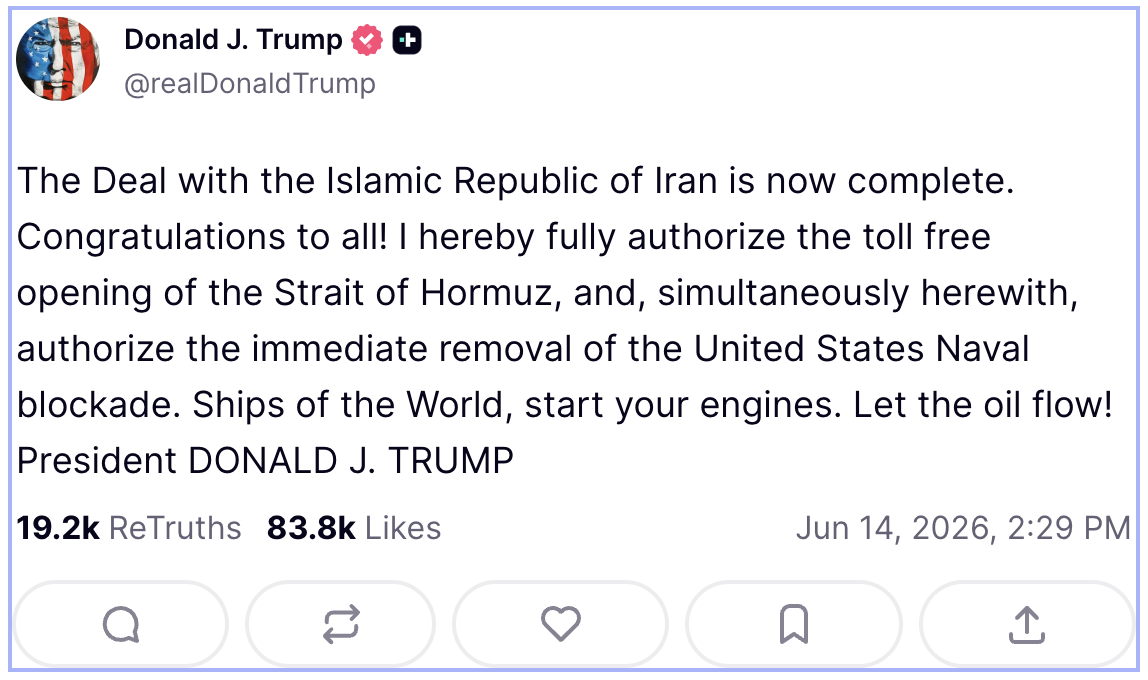
On Sunday (June 14th), President Trump announced a peace deal with Iran via a Truth Social post:
The Deal with the Islamic Republic of Iran is now complete. Congratulations to all! I hereby fully authorize the toll free opening of the Strait of Hormuz, and, simultaneously herewith, authorize the immediate removal of the United States Naval blockade. Ships of the World, start your engines. Let the oil flow!
While the details of the deal haven’t been released yet, it was positive news to start the week with for the international shipping industry. But what exactly is its impact for shippers?
We do have some answers to that question…
Oil Prices Down But Not Freight Rates
The impact of the Iran Peace Deal was immediate for oil prices.
They were already significantly lower than the peak price per barrel after the Iran War started, but oil prices were still well above their pre-war rates.
Since Sunday’s announcement, oil prices have been falling, though still not quite to pre-war levels:
| Date | Brent Crude (Global) | WTI Crude (US) |
|---|---|---|
| Friday, June 12 (Pre-Announcement) | $85.29 | $82.10 |
| Monday, June 15 (Day 1 Post-Deal) | $83.17 | $80.75 |
| Tuesday, June 16 (Today) | $78.94 | $76.02 |
| Late February (Pre-War) | $68 – $70 | $71 – $72 |
| March/May (Peak) | $119 – $120 | $120.43 |
Falling oil prices don’t mean lower freight rates for shippers.
General Rate Increases (GRIs) and Peak Season Surcharges (PSS) from ocean freight carriers remain in effect. It would be extremely unlikely for dropping oil prices to translate to better freight rates for shippers this quickly anyway, but shipping demand is up right, helping boost current freight rates anyway.
Many look at the current high shipping demand as an early start to the peak season. However, this could be a case of many shippers frontloading cargo they would have shipped during the peak season to beat potential Section 301 tariff increases from the Trump Administration. Tariff refunds may be helping to boost this early shipping as well.
We’ll have to watch, but this early shipping could mean a muted peak season. If the higher demand we’re seeing right now dries up, the lower oil prices may be one more factor in making it difficult for carriers to maintain higher freight rates through the typical height of peak season months in August and September, let alone October and November.
Strait of Hormuz Opening But Carriers Cautious
There are some reports of new shipping activity in the Persian Gulf in the wake of the Iran Peace Deal announcement. Even still, carriers are not rushing to ship through the Strait of Hormuz.
Greg Knowler wrote an excellent article in the Journal of Commerce titled “Shipping wants clarity on US-Iran deal before Hormuz transits can resume,” in which he highlighted the cautious approach carriers are taking to resuming shipping in the region:
“Due to lack of details and a history of overly optimistic reassurances, we believe the security situation for the shipping industry remains volatile, and we still consider it very risky for ships to commence transits at this point,” Larsen said in a statement Monday. “We advise shipowners to continue doing thorough risk assessments and appeal to all parties to put the safety of seafarers first.”
Hapag-Lloyd is reevaluating its risk assessment for the transiting of vessels through the Strait of Hormuz following the US-Iran agreement, a spokesperson for the carrier told the Journal of Commerce.
“We are reviewing the available information and working closely with the relevant authorities and our security partners to ensure a safe passage,” he said. “Still, the safety of our crews and vessels, as well as the security of our customers’ cargo, remain our highest priorities.”
Maersk said in a statement that publicly available details of the deal were limited and that it was too early to make any changes to its logistics and maritime operations in the region.
A senior executive from another carrier said commercial pressure to resume both Strait of Hormuz and Red Sea/Suez Canal voyages would come from customers the moment it was considered safe to use the waterways. But the source said shippers have emphasized that Hormuz and the Red Sea must be safe to transit to avoid a start-stop scenario that was highly disruptive to network planning.
While carriers have had ships trapped in the Persian Gulf during the Iran War, its impact on global capacity is very small. Even with a full, immediate return to regular shipping through the Strait of Hormuz, it would not create a large enough influx of capacity to really impact freight rates.
Shippers shouldn’t expect a sudden drop of freight rates because of supply side economics. Freight rates will be much more dependent on what happens with demand for the moment. While the current shipping demand remains strong, shippers should expect freight rates to remain at the higher rates they’re currently seeing.